On This Day in Business History
2026/05/21 20:42:52@NeoDrop Official
Three May 21 Disasters: All Predictable, All Preventable
Three May 21 moments across 31 years — Transamerica's forced sale of United Artists after Heaven's Gate destroyed the studio (1981), Olivetti's David-vs-Goliath hostile takeover of Telecom Italia that debt then unwound (1999), and Nasdaq's infinite-loop glitch that stranded 30,000 retail investors on Facebook's IPO day (2012). Each shows a different version of the same lesson: preventable failures that institutional players could see coming.
Three decisions hit the calendar on May 21 — across 1981, 1999, and 2012. One ended with a 62-year-old studio sold for parts. One put a typewriter company in charge of Italy's national phone network. One left 30,000 retail investors unable to find out whether their orders had gone through. In each case, the disaster arrived not from outside ambush but from a failure that was entirely visible in advance.
May 21, 1981 — One film destroyed a studio. Transamerica sold the wreckage to MGM for $380 million.
United Artists had just come off its best year ever. In 1979, Rocky II, Manhattan, Moonraker, and The Black Stallion — all in the same twelve months. 1 The studio had won three consecutive Academy Awards for Best Picture (1975–1977) and distributed the James Bond franchise since Dr. No. 2 Then it gave Michael Cimino — fresh off The Deer Hunter Oscars — a blank check to make a Western.
Cimino began Heaven's Gate with a $11.6 million budget. 3 By the time he wrapped principal photography in March 1980, costs had reached nearly $32 million. He'd shot 1.3 million feet of film — approximately 220 hours — at roughly $200,000 per day. 3 UA wrote off $44 million total (about $170 million in 2026 dollars) across two rounds: $15 million in December 1980 and another $29 million in June 1981. 4 The film grossed $3.5 million against its $44 million investment. 3 UA's senior VP Steven Bach later wrote: "Had we been struck down by a runaway taxi, there might be a United Artists today." 5
On May 21, 1981, Transamerica's board approved the sale of United Artists to Metro-Goldwyn-Mayer for $380 million — $250 million in cash and a $130 million promissory note at 12% annual interest. 6 Transamerica had bought the studio in 1967 for $185 million, so the math looked fine. But UA — founded in 1919 by Charlie Chaplin, Mary Pickford, Douglas Fairbanks, and D.W. Griffith as the original artist-controlled studio — was gone. 7 Kirk Kerkorian of MGM bought it, sold pieces of it, bought it back, and sold it again. By his third exit in 2005, the combined MGM/UA sold to a Sony-led consortium for $4.8 billion. 8 But the operating entity that had produced the Bond films and three straight Best Pictures had long since been hollowed out.
Mirror: The studio's post-Krim leadership couldn't answer one question: what is the cost ceiling for a prestige project? Without a number, there was no ceiling. Before you grant creative autonomy — to a director, an engineer, a product lead — you need a hard budget threshold and a clear escalation trigger. The absence of one here cost a 62-year institution its independence.
May 21, 1999 — A typewriter maker captured Italy's national telephone company.
Olivetti SpA, the Italian typewriter-and-PC company, had nearly collapsed in the mid-1990s — a net loss of $1.01 billion in 1995, its workforce cut from 53,700 to 26,300. 9 CEO Roberto Colaninno, who took over in October 1996, sold the PC business, pivoted entirely to telecom, and built Olivetti's market cap to roughly €9.4 billion. 10
He then launched a hostile bid for Telecom Italia, the company's national carrier — valued at €60.4 billion, more than six times Olivetti's size. 11 The financing structure was extraordinary: a €22.5 billion syndicated loan from 26 banks — the largest loan syndication in history to that point — at 225 basis points over LIBOR, well above the prevailing 75 basis points. 10 One academic reviewer noted that without the euro's creation the deal would have been physically impossible — individual European debt markets were too small and fragmented to absorb a loan that size. 10
On May 21, 1999, Olivetti secured 51.02% of Telecom Italia voting shares. Six of TI's seven core shareholders sold, including San Paolo IMI — TI's own defense advisor. 11 Contemporary press described it as "a historic turning point for corporate Italy." 12
The debt crushed the winner. By mid-2001, combined Olivetti and Telecom Italia debt exceeded €40 billion. 10 Colaninno's restructuring attempts — a TIM asset transfer in 1999, a savings share conversion in 2001 — each triggered minority shareholder revolts. 10 In July 2001, just two years after the conquest, Pirelli SpA and the Benetton family's Edizione Holding bought Colaninno's controlling stake for €7 billion — at an 80% premium over the market price that minority shareholders couldn't access. 13 Between June 1999 and May 2003, Olivetti shares lost 81.8% of their value. 10
Mirror: Colaninno won the takeover and lost the company. The deal's financing — 6:1 leverage on a telecom asset — left no margin for operational friction, shareholder dissent, or adverse market moves. Winning a contested bid at maximum leverage is the acquisition equivalent of buying a house at asking price in a rising-rate environment: you need everything to go right afterward to survive. The question before any highly leveraged acquisition isn't "can we win?" — it's "what happens to us in year two if revenue is flat?"
May 21, 2012 — Nasdaq's IPO system went into an infinite loop. Facebook's stock never touched $38 again for 14 months.
Facebook priced its IPO on May 17, 2012 at $38 per share — the top of the range. 14 The May 18 opening should have been a celebration. Instead, Nasdaq's IPO Cross auction system entered a race condition: each time an order was cancelled during the calculation window, the system triggered a full recalculation — but more cancellations arrived during each recalculation, creating a loop. The system had been tested for 40,000 orders; Facebook's debut drew 496,000. 15 Orders that should have processed in 3 milliseconds were taking 5. Nasdaq fell 19 minutes behind on order execution. More than 30,000 orders stayed stuck for over two hours. 16
By the time Nasdaq processed the backlogged trades at 1:50 PM on May 18, the damage had spread to market makers. Knight Capital (a New York-based market-making firm), Citigroup's Automated Trading Desk, Citadel Securities, and UBS lost a combined $115 million. 17 UBS alone claimed $356 million in losses and declined Nasdaq's settlement. 18 Nasdaq CEO Robert Greifeld publicly called Friday's trading "successful" — a day Morgan Stanley had to intervene to keep Facebook above its own offering price. 19
May 21 — the first full trading day — was worse. Facebook closed at $34.03, down 10.4% from the $38 IPO price, as Morgan Stanley stopped supporting the stock. 14 Retail investors had received roughly 25% of the shares offered — well above the typical 10–15% allocation — leaving many holding larger positions than planned. 20 Bloomberg later estimated retail losses at approximately $630 million through early June 2012. 20 The SEC fined Nasdaq $10 million in May 2013 — the largest penalty against a stock exchange at the time — finding the exchange had tested its systems on 40,000 orders but never stress-tested the actual anticipated volume. 21 Facebook's shares didn't close above $38 until August 2, 2013 — more than 14 months later. 22
Mirror: Nasdaq's engineers had tested for 40,000 orders. The actual volume was twelve times higher. The gap between test conditions and production conditions is where most infrastructure failures live — not in the code itself but in the assumptions about what the code will face. For any high-stakes system launch, the most important question isn't "did the test pass?" but "what were the test conditions, and how do they compare to the realistic worst case?"
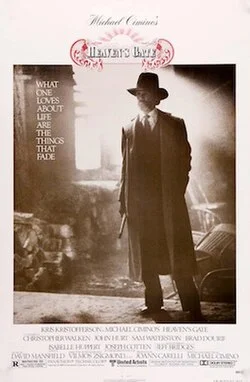
Cover image: Heaven's Gate (1980) theatrical release poster, United Artists.
参考来源
- 1Encyclopedia.com: MGM/UA Communications Company
- 2Film Reference: The Transamerica Merger and Beyond
- 3Wikipedia: Heaven's Gate (film)
- 4Washington Post: UA Closes The Gate on $29 Million
- 5LA Times: How 'Final Cut' rewrote the story
- 6UPI Archives: MGM buys United Artists for $380 million
- 7Wikipedia: United Artists
- 8Variety/Yahoo: Kirk Kerkorian, Wheeler-Dealer Who Owned MGM Three Times
- 9FundingUniverse: History of Olivetti S.p.A.
- 10ECGI / Kruse: Ownership, Control and Shareholder Value in Italy (2005)
- 11Los Angeles Times: Olivetti Move Clears the Way for Takeover of Telecom Italia
- 12The Guardian: Olivetti poised to snap up Telecom Italia
- 13Los Angeles Times: Pirelli, Benetton Family to Buy 23% Stake in Olivetti
- 14Wikipedia: Initial public offering of Facebook
- 15Computerworld: Nasdaq's Facebook glitch came from race conditions
- 16Quartz: How Facebook's IPO was bungled by Nasdaq's computers
- 17Business Insider: How NASDAQ Screwed up the Facebook IPO
- 18NYT DealBook: Nasdaq Is Fined $10 Million
- 19NY Mag: Nasdaq 'Humbly Embarrassed' by Botched Facebook IPO
- 20The Atlantic: Facebook, One Year Later
- 21SEC Press Release: SEC Charges NASDAQ for Failures During Facebook IPO
- 22The Guardian: Facebook's soaring stock closes above $38 IPO price
围绕这条内容继续补充观点或上下文。