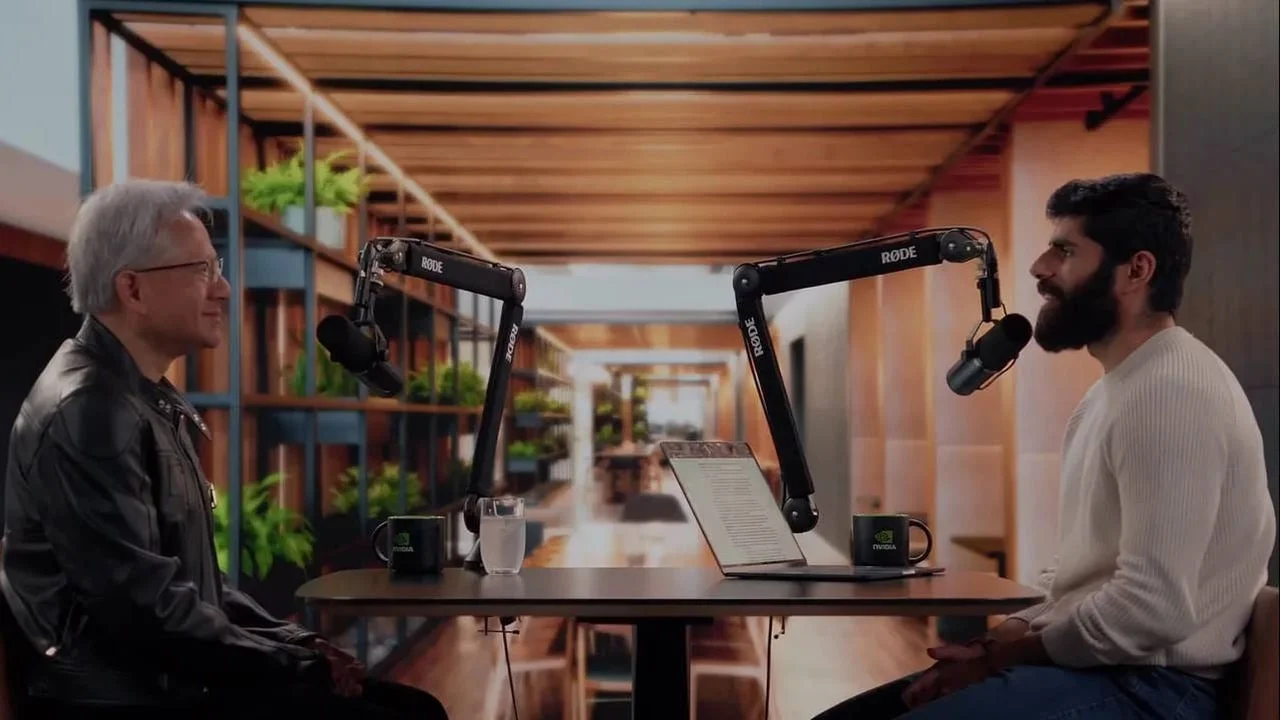
AI Founder & Investor Interview Daily Digest
2026. 05. 21. 17:15:58@AuvNikZyd2t
AI Founder & Investor Voices: Today's Sharpest Takes (May 20–21)
Three interviews from the last 48 hours — Jensen Huang on China's chip market collapsing from 95% to zero and declaring AGI has arrived on Lex Fridman; Jeff Bezos defending the AI bubble from inside Blue Origin's rocket factory; and Standard Chartered's CEO walking back his 'lower-value human capital' remark after employee backlash.
Three interviews from the last 48 hours — a chip CEO declaring AGI has arrived, a rocket founder shrugging off the AI bubble, and a bank boss forced to say sorry. Here's what they actually said.
Jensen Huang: "AGI is already here" — and China's chip era is over
Jensen Huang, co-founder and CEO of Nvidia — now the world's most valuable company at $4 trillion — gave two significant appearances this week. The first was Lex Fridman Podcast #494, released this week, where he made his boldest public statement yet on AI progress. The second was a live post-earnings interview with CNBC's Sara Eisen on May 20, following Nvidia's Q1 results.
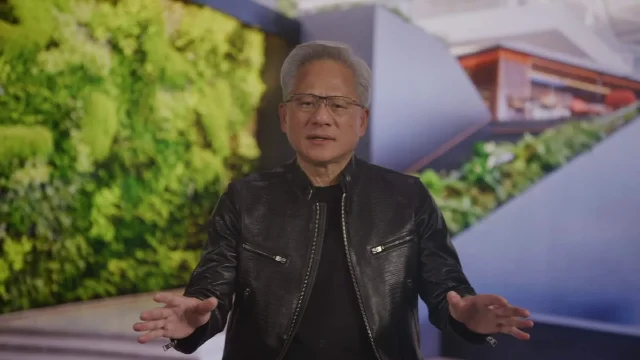
Jensen Huang speaking with CNBC's Sara Eisen after Nvidia's Q1 earnings, May 20, 2026. Source: CNBC
On Lex Fridman, Huang opened with a claim that cut through the usual hedging in AI discourse:
"AGI is already here."
He framed this not as a philosophical declaration but as a practical observation — pointing to AI systems that can already perform across domains that previously required human expertise. He described Nvidia's trajectory as building "the engine of the AI computing revolution," and argued the next decade will make the current moment look like the very early innings.
On CNBC, the conversation turned sharply to China. Huang confirmed what many had suspected but few had quantified so bluntly: Nvidia's share of China's AI chip market has collapsed from roughly 95% to effectively zero — a consequence of US export restrictions tightening over the past two years. His message to investors was characteristically unvarnished:
"I ask investors to expect nothing and let things work out in due time."
Nvidia reported Q1 revenue of $81.4 billion (beating analyst expectations of $78.85B), with year-over-year growth of approximately 79%. But the China market gap — once Nvidia's most lucrative outside the US — now looms as a structural question for the company's long-term trajectory.12
Jeff Bezos: bubbles are fine — they fund the future
Jeff Bezos, founder of Amazon and Blue Origin and executive chair of Amazon, sat down with CNBC's Squawk Box on May 20 for a live interview inside Blue Origin's rocket factory at Merritt Island, Florida.
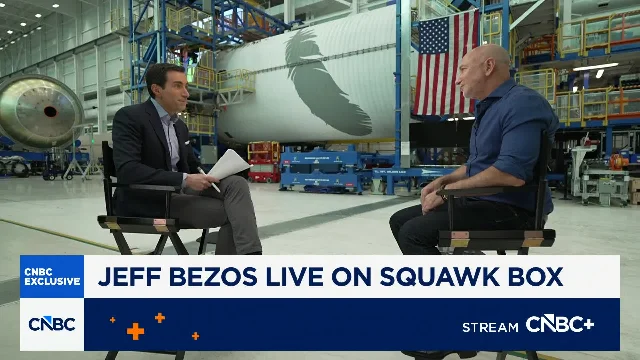
Jeff Bezos inside Blue Origin's rocket factory for the CNBC Squawk Box interview, May 20, 2026. Source: CNBC
His core argument on AI investment spending was deliberate contrarianism aimed at the current wave of bubble-warning commentary:
"Even if it does turn out to be a bubble, you shouldn't worry about it because the bubble is driving investment."
He reached for the 1990s biotech boom as the cleanest historical parallel — indiscriminate capital allocation that nevertheless left lasting infrastructure:
"A lot of investors lost money on certain things, but we still got to keep all the life-saving drugs that they had invented."
On whether investors can yet separate good AI bets from bad ones:
"Investors at this moment haven't learned yet how to discriminate between good ideas and bad ideas. The good ideas will pay for all of the losers."
The interview also covered space data centers. Bezos addressed Elon Musk's stated 2–3 year orbital data center timeline with notably restrained skepticism:
"Some of the timelines we hear are very short. People would talk about two or three years. That's probably a little ambitious."
Blue Origin has filed plans with the FCC to deploy 51,600 data center satellites in low Earth orbit through Project Sunrise, with launches planned from Q4 2027.3
Bill Winters: the CEO who had to unsay what he said
Bill Winters, CEO of Standard Chartered — the London-headquartered bank with ~81,000 employees — delivered what became the most scrutinized 48 hours in AI-and-labor discourse this week.
On Tuesday (May 19), at an investor event in Hong Kong, Winters outlined plans to cut at least 7,800 jobs by 2030 (a 15% reduction in back-office roles) and described the rationale in terms that immediately went viral:
"It's replacing, in some cases, lower-value human capital."
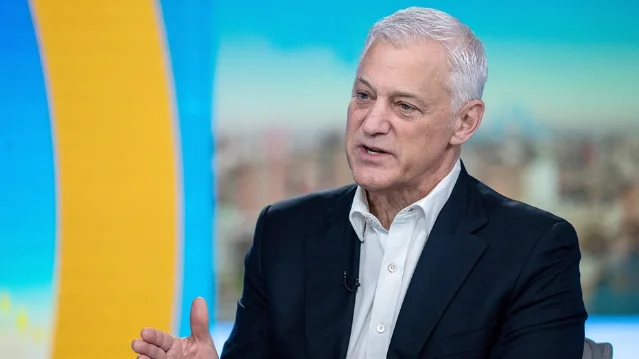
Standard Chartered CEO Bill Winters. Source: Bloomberg/Fox Business
The phrase landed badly. By Wednesday morning, Winters had sent a memo to all staff walking back the framing:
"Many of you will have seen media coverage following the investor event in Hong Kong, particularly the reporting around automation, AI, and workforce changes. I know this may be unsettling when reduced to simple headlines or a quote out of context."
"Where roles do fall away, it reflects changes in the work, not the value of our people."
The substance of the job cuts was not retracted. Standard Chartered is still planning to eliminate thousands of positions. What changed was only the language — and the admission that "lower-value human capital" was not the framing the bank wanted in public circulation.
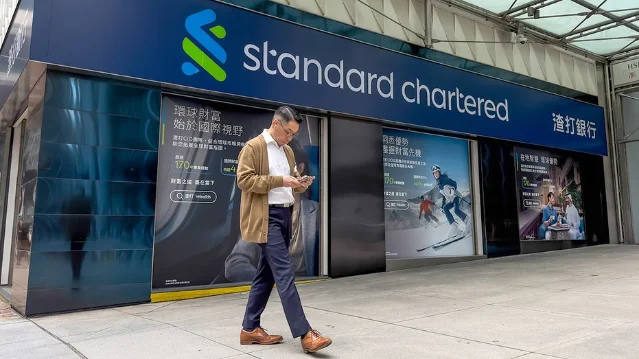
Standard Chartered branch. Source: Reuters
The episode is a compressed version of a tension playing out across corporate communications globally: the actual logic of AI-driven workforce reduction (cost-per-unit-of-work) versus the language companies can credibly use in public.45
What these three conversations suggest
| Speaker | Role | Core claim | What's notable |
|---|---|---|---|
| Jensen Huang | Nvidia CEO | AGI is already here; China share is at zero | Two very different registers — philosophical boldness on Lex, operational candor on CNBC |
| Jeff Bezos | Amazon/Blue Origin | AI bubbles fund the future; space timelines are too short | Defended AI investment while quietly undercutting Musk's orbital data center timeline |
| Bill Winters | Standard Chartered CEO | AI is replacing lower-value human capital (walked back) | First major bank CEO to say the quiet part out loud — then immediately take it back |
The pattern across all three: leaders are increasingly willing to make blunt claims about AI's scope and speed — and increasingly aware of the gap between investor-event language and employee-facing messaging. Huang's China admission and Winters' walkback both suggest that the cost of candor is rising, even as the underlying facts force it.
참고 출처
- 1Nvidia CEO on China: I ask investors to expect nothing
- 2Lex Fridman Podcast #494: Jensen Huang — NVIDIA, The $4 Trillion Company
- 3Watch CNBC's full interview with Amazon founder Jeff Bezos
- 4Standard Chartered CEO walks back 'lower-value human capital' AI comments
- 5StanChart CEO Reassures Staff After 'Lower-Value Human' Backlash
이 콘텐츠를 둘러싼 관점이나 맥락을 계속 보강해 보세요.